Hyundai Parts Manual Guide: How to Identify the Right Parts for Forklifts & Excavators
Introduction
Incorrect spare parts are one of the most common reasons behind equipment downtime, repeat repairs, and increased maintenance costs. In heavy equipment like Hyundai forklifts and excavators, even a small mismatch in components can lead to performance issues and system failure.
Instead of relying on guesswork, technicians and operators use structured parts manuals to accurately identify and order the correct components. These manuals provide detailed diagrams, OEM part numbers, and system breakdowns that simplify the entire repair process.
This guide explains how to use Hyundai parts manuals effectively to identify the right parts and ensure reliable machine performance.
Equipment & System Overview
Hyundai equipment, such as forklifts and excavators, operates through multiple interconnected systems:
-
Engine system
-
Hydraulic system
-
Transmission and drivetrain
-
Electrical components
-
Structural assemblies
Each system depends on precise parts compatibility. Using incorrect components can disrupt system balance, reduce efficiency, and lead to further damage.
What is a Parts Manual?
A parts manual is a technical document used to identify and reference machine components.
It is different from other manuals:
-
Service manual → Used for repair and diagnostics
-
Operator manual → Used for machine operation
-
Parts manual → Used for identifying and ordering components
Parts manuals ensure that the correct spare parts are selected based on the machine model, configuration, and serial compatibility.
What’s Inside a Hyundai Parts Manual
A standard Hyundai parts manual includes:
-
Exploded diagrams showing component structure
-
OEM part numbers for accurate ordering
-
System-wise component grouping
-
Assembly-level breakdown for detailed identification
These features help technicians locate the exact part quickly without confusion or trial-and-error.
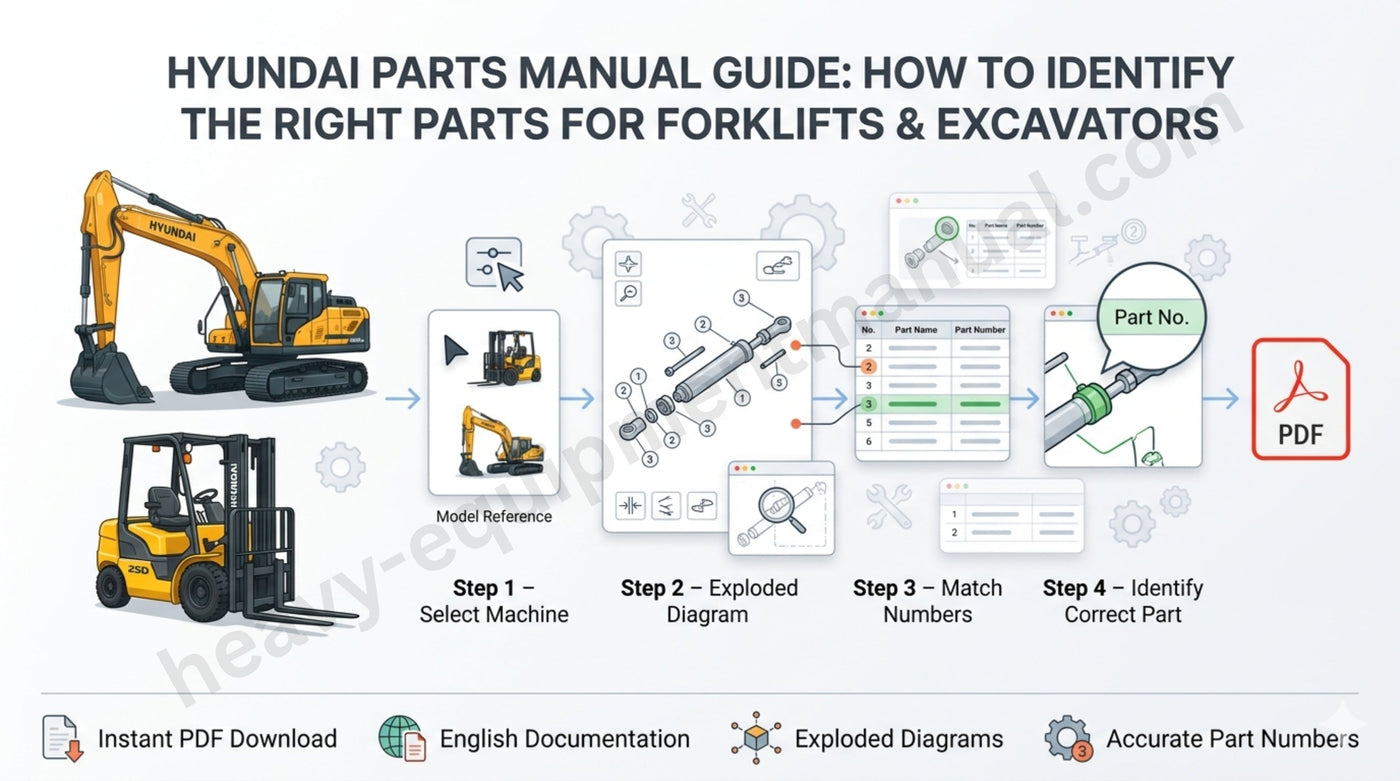
Step-by-Step Parts Identification Process
A structured approach ensures accurate part selection and avoids unnecessary replacements.
1. Identify the System
Determine whether the issue is related to the engine, hydraulics, transmission, or electrical system.
2. Open the Diagram
Use the parts manual to locate the relevant system diagram.
3. Locate the Component
Identify the faulty component visually within the exploded diagram.
4. Match the Part Number
Refer to the corresponding OEM part number listed in the manual.
5. Verify Compatibility
Confirm the part matches the machine model and serial specifications before ordering.
Forklift Parts Identification Using Detailed Parts Manuals
Technicians working on Hyundai forklifts often rely on detailed catalogs such as the <a Hyundai 20–35LE-7 Forklift Parts Manual PDF. This manual provides a complete visual breakdown of the equipment through exploded diagrams, allowing users to clearly identify each component and its placement within the machine. With structured sections covering engine, hydraulic, electrical, and structural groups, along with accurate OEM part numbers, it ensures that parts can be identified and ordered without confusion or errors.
Parts Catalog Reference for Model Compatibility
For similar forklift models, the Hyundai 20–35D-7SA Forklift Parts Catalog Manual is used to support accurate part identification across different configurations. This catalog helps technicians match parts based on machine and serial compatibility, reducing the risk of incorrect replacements. It serves as a reliable reference for locating original spare parts and simplifying the ordering process.
Heavy Equipment Parts Breakdown for Excavators
In heavy-duty equipment applications, manuals like the Hyundai R220LS Excavator Parts Manual PDF are essential for handling complex systems. This catalog provides detailed system-wise breakdowns, including engine, fuel system, wheels, and other critical assemblies. With searchable, bookmarked sections and high-quality diagrams, technicians can quickly locate components and understand their relationships within the machine. This is especially important in large excavators where precise part identification directly impacts repair efficiency.
Common Mistakes to Avoid
Avoid these errors during part identification:
-
Using the wrong manual for the machine model
-
Guessing part numbers without verification
-
Ignoring machine serial compatibility
-
Replacing parts without diagnosing the root issue
These mistakes can lead to repeated failures and increased repair costs.
Benefits of Using Parts Manuals
Using a proper parts manual provides several advantages:
✔ Accurate part identification
✔ Faster repair process
✔ Reduced downtime
✔ Cost-efficient maintenance
✔ Improved machine reliability
Practical Insight
Technicians working with multiple machines rely on parts manuals alongside service and maintenance guides to maintain consistency in diagnostics, repairs, and component replacement. This structured approach reduces errors and improves overall efficiency in workshop and field operations.
Conclusion
Proper part identification is critical for maintaining the performance and reliability of Hyundai equipment. A structured parts manual eliminates guesswork and ensures that the correct components are selected every time.
By following a step-by-step identification process and using accurate documentation, technicians can reduce downtime, improve repair accuracy, and extend equipment life.
Always refer to the correct parts manual before ordering or replacing any component.
❓ FAQs
Q1: What is a parts manual used for?
A parts manual is used to identify machine components and find the correct part numbers for replacement.
Q2: How do I find the correct part number?
Use the exploded diagrams in the parts manual and match the component with its listed OEM part number.
Q3: Is a parts manual different from a service manual?
Yes, a service manual is used for repair procedures, while a parts manual is used for identifying and ordering parts.
Q4: Can I use the same parts manual for different models?
No, each model has a specific manual. Always verify compatibility before using it.
Q5: Why is correct part identification important?
Using the correct part prevents system damage, reduces downtime, and ensures proper machine performance.