

Step-by-Step Maintenance & Diagnostic Troubleshooting (HL760-9)
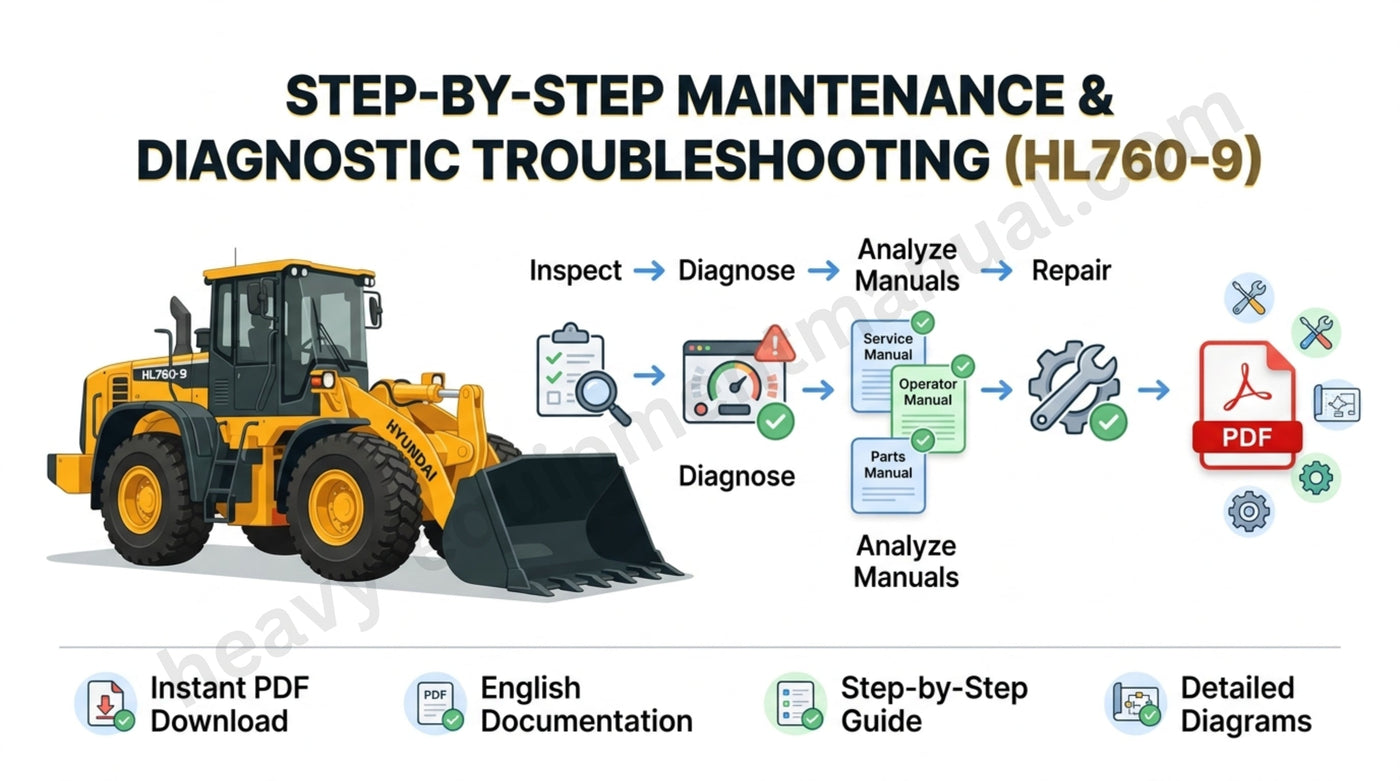
A structured troubleshooting approach helps technicians isolate faults quickly without unnecessary part replacement. Follow this sequence for accurate diagnostics.
1. Initial Machine Behavior Assessment
Start by observing machine performance under normal operation.
Identify:
• Delayed bucket movement
• Weak lifting under load
• Irregular steering response
• Unusual vibration or noise
• Overheating during continuous cycles
These symptoms indicate whether the issue is hydraulic, mechanical, or electrical.
2. Visual Inspection
Before using diagnostic tools, inspect the machine physically.
Check:
• Hydraulic hose leaks or cracks
• Loose fittings or damaged connectors
• Oil seepage around cylinders
• Electrical wiring damage
• Low fluid levels
Many performance issues originate from simple, visible faults.
3. Fluid & Filter Condition Check
System efficiency depends heavily on fluid quality.
Inspect:
• Dark or degraded hydraulic oil
• Cloudy fluid (moisture contamination)
• Presence of metal particles
• Blocked or clogged filters
If contamination is found, replace fluid and filters before further diagnostics.
4. Hydraulic System Testing
Hydraulic imbalance is a common cause of performance issues.
Measure:
• Main system pressure
• Steering circuit pressure
• Relief valve activation
Interpretation:
• Low pressure → Pump wear or internal leakage
• High pressure → Valve restriction or calibration issue
Always compare readings with standard specifications.
For accurate system values, pressure limits, and diagnostic procedures, technicians refer to the Hyundai HL760-9 Service Repair Manual PDF, which provides detailed calibration data and hydraulic system diagrams.
5. Pump Performance Evaluation
The hydraulic pump controls system flow and pressure.
Check for:
• Reduced output flow
• Pressure drop under load
• Overheating
• Cavitation noise
Pump inefficiency directly impacts machine response and lifting performance.
6. Cylinder & Actuator Inspection
Cylinder faults affect lifting and tilting operations.
Inspect:
• Slow or uneven movement
• Seal leakage
• Cylinder drift in neutral position
• Rod surface damage
These signs indicate internal leakage or worn seals.
7. Control Valve Diagnostics
If pressure is normal but performance is inconsistent, inspect control valves.
Check:
• Spool movement smoothness
• Internal flow restriction
• Sensor and wiring connections
Valve issues can restrict hydraulic flow, causing a delayed response.
8. Electrical & Signal Check
Electrical faults can mimic hydraulic problems.
Inspect:
• Wiring harness integrity
• Sensor outputs
• Control unit signals
• Dashboard warning indicators
Accurate signal flow is essential for system coordination.
Key Diagnostic Insight
Technicians working on HL760-9 often combine inspection + pressure testing + component evaluation rather than relying on a single step.
Skipping any stage can lead to incorrect diagnosis and repeated failures.
Common Mistakes to Avoid
• Diagnosing without pressure testing
• Ignoring fluid contamination
• Replacing parts without confirming the root cause
• Skipping initial inspection
• Using incorrect specifications
Avoiding these improves repair accuracy and reduces downtime.
Conclusion
Troubleshooting the Hyundai HL760-9 Wheel Loader requires a methodical and step-by-step approach. From visual inspection to system testing and component analysis, each stage plays a critical role in identifying the root cause of issues.
Following a structured diagnostic process ensures efficient repairs, minimizes downtime, and maintains consistent machine performance.



)