Heavy Equipment Manual: Why Service Manual Matters for Maintenance and Repairs
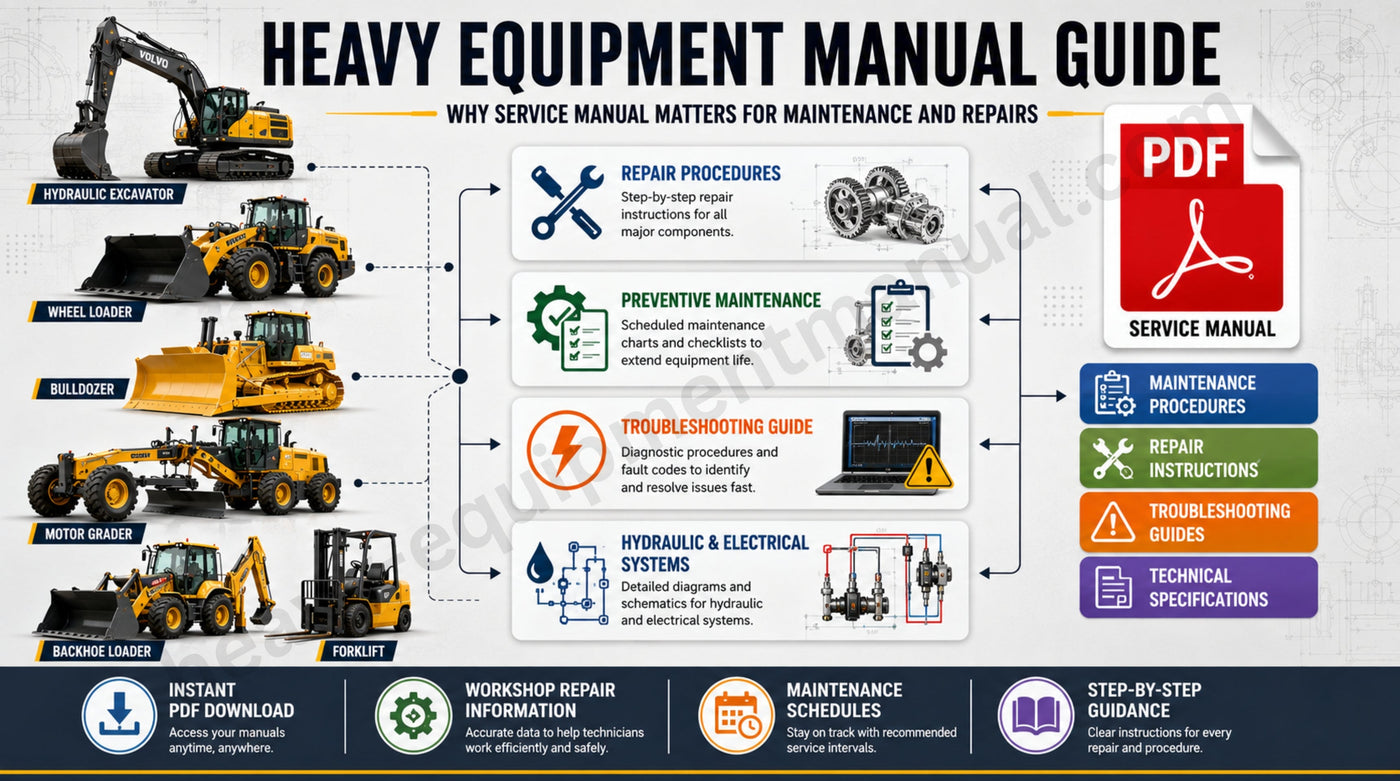
A heavy equipment manual provides structured repair instructions, maintenance procedures, diagnostics, and technical specifications used by mechanics, technicians, operators, and workshop teams. The right manual helps reduce equipment downtime, improve repair accuracy, and support safer machine servicing by replacing guesswork with documented procedures.
Whether maintaining construction machinery, engines, loaders, excavators, forklifts, or industrial equipment, having access to the correct manual often determines how efficiently repairs are completed.
What is a heavy equipment manual, and how is it used?
A heavy equipment manual is a technical reference created to support equipment operation, maintenance, diagnostics, servicing, and repairs throughout a machine’s working life.
A manual helps users:
- Perform maintenance correctly
- Troubleshoot faults faster
- Follow manufacturer procedures
- Improve machine reliability
- Reduce unnecessary downtime
Unlike general reference material, a manual is designed to support real workshop and field work.
To explore machine documentation, manual categories, and available equipment support resources, visit our heavy equipment manual page.
Professional workshops often use a manual as part of their standard maintenance workflow.
What are the types of manual used in heavy equipment operation?
Different manual types serve different stages of machine ownership and maintenance.
Operator Manual
Used for machine controls, operating instructions, inspections, and safe equipment use.
Service Manual
Used for diagnostics, maintenance schedules, testing procedures, and servicing activities. A PDF service manual is helpful when technicians need searchable repair and maintenance information.
Repair Manual
Used for deeper technical repairs, disassembly procedures, and component restoration. A PDF repair manual helps technicians follow repair steps without relying on guesswork.
Parts Manual
Used for parts identification, exploded diagrams, and replacement planning. A parts manual PDF helps confirm the correct component before ordering or replacing parts.
Using the correct manual type helps improve maintenance quality and reduce servicing errors.
For more examples and maintenance insights, review our Heavy Equipment Maintenance and Repair Guide.
What does a heavy equipment service manual include?
A heavy equipment service manual is a manufacturer-issued technical document created to support equipment servicing and diagnostics.
A complete service manual may include:
- Step-by-step repair instructions
- Technical specifications
- Preventive maintenance schedules
- Electrical and hydraulic schematics
- Parts references
Step-by-step repair instructions explain factory-approved procedures for removing, servicing, repairing, and reinstalling machine components.
Technical specifications may include torque values, fluid capacities, operating limits, and service tolerances.
Preventive maintenance schedules help technicians follow recommended intervals for inspections, lubrication, filter changes, and component checks.
Electrical and hydraulic schematics help identify wiring faults, hydraulic system issues, and component locations.
A PDF OEM service manual is especially useful for workshops that need model-specific repair guidance, accurate diagrams, and structured troubleshooting support.
Why do workshops prefer OEM service manual documentation?
|
Feature |
OEM Service Manual |
General Information |
|
Repair Procedures |
Factory Based |
General |
|
Diagnostics |
Detailed |
Limited |
|
Technical Accuracy |
High |
Moderate |
|
Service Planning |
Complete |
Partial |
|
Maintenance Support |
Structured |
Basic |
Professional repair teams usually prefer OEM service manual documentation because modern equipment systems are increasingly specialized. Teams managing multiple machine categories often rely on documented procedures to maintain consistency.
For additional insights into factory documentation and workshop support, review our OEM Heavy Equipment Manual Guide.
Who prepares the O&M manual, and why does it matter?
Operation and Maintenance (O&M) manuals are generally prepared by equipment manufacturers and technical engineering teams.
An O&M manual combines operation instructions with maintenance requirements and helps users:
- Follow service intervals
- Improve equipment lifespan
- Maintain safer operating practices
- Reduce preventable failures
- Standardize workshop procedures
Because an O&M manual is built around manufacturer recommendations, it remains one of the most reliable references during maintenance work.
You can also browse additional equipment resources from the Heavy Equipment Manual homepage.
Conclusion
A heavy equipment manual does more than explain repairs. It organizes maintenance procedures, diagnostics, service information, and operating guidance into a repeatable workflow that supports technicians and equipment owners.
Using the correct manual improves maintenance quality, supports safer repairs, and helps reduce avoidable downtime across workshop and field environments.
Frequently Asked Questions
What is a heavy equipment manual?
A heavy equipment manual provides operation, maintenance, diagnostics, repair, and technical guidance for machinery.
What are the 4 types of manual?
The main types are operator manual, service manual, repair manual, and parts manual.
What does a PDF service manual include?
A PDF service manual may include maintenance schedules, diagnostics, repair procedures, technical specifications, wiring diagrams, and troubleshooting guidance.
What is a PDF repair manual used for?
A PDF repair manual is used for component-level repairs, disassembly procedures, system troubleshooting, and step-by-step repair work.
What is a parts manual PDF?
A parts manual PDF helps identify components using diagrams, part references, and assembly details before ordering replacement parts.
Who prepares the O&M manual?
An O&M manual is typically prepared by equipment manufacturers and technical documentation teams.